As an Amazon Associate, we earn from qualifying purchases. Some links on this site are affiliate links at no extra cost to you. Our recommendations are based on thorough research and editorial judgment.


Cable Gauge and Heat: Why Wire Thickness Impacts Charging Speed

Cable gauge noticeably impacts charging speed due to resistance variations. Thicker wires, such as AWG 24, offer lower resistance and can handle up to 3.5A, while AWG 28 wires limit power to 2A due to higher resistance of about 0.5 ohms over 2 meters. This increased resistance leads to heat generation and efficiency loss. Shorter cables further enhance performance, minimizing voltage drop. Understanding these differences can help users select better charging options to optimize their devices. More insights await.
Key Takeaways
- Thicker wires (lower AWG) have less resistance, allowing for greater current flow and improved charging speed.
- Higher resistance in thinner wires (AWG 28) leads to significant heat generation, reducing efficiency during charging.
- Longer cables increase resistance, further hindering charging speed and efficiency, especially with thinner wire gauges.
- Fast charging cables typically use thicker wires (24-26 AWG) to manage heat better and support higher power delivery.
- Effective heat management in cables is crucial to prevent overheating and optimize charging performance during fast charging sessions.
Understanding Cable Gauge
You may be interested


Cable gauge plays an essential role in determining the performance of electrical wiring, particularly in relation to current carrying capacity and resistance. The thickness of a wire, measured in American Wire Gauge (AWG), directly affects charging speed and efficiency. For example, USB cables using AWG 28 have higher resistance, limiting power transfer to 5V and 2A. Conversely, a thicker wire gauge, like AWG 24, provides lower resistance, enabling higher current levels of 3.5A or more. A significant voltage drop occurs over longer, thinner cables, negatively impacting performance. Selecting a fast charging cable rated for ideal current specifications guarantees faster charging while minimizing heat generation, making it essential for effective electrical performance in charging applications. Additionally, choosing USB-C cables supporting USB 3.1 can further enhance data transfer rates alongside charging efficiency.
How Wire Thickness Affects Resistance

Resistance considerably influences the efficiency of electrical wiring, particularly in the context of wire thickness. The wire gauge, measured in AWG, directly impacts electrical resistance; thinner wires, such as AWG 28, exhibit higher resistance than thicker wires, like AWG 24. For example, the resistance of an AWG 28 wire can reach about 0.5 ohms over 2 meters, considerably limiting power transfer and reducing charging speed. A decrease in thickness can lead to nearly a 40% increase in resistance, which hampers charging efficiency, particularly at higher current levels. By utilizing thicker wires, less resistance allows for greater current delivery, enhancing charging efficiency and ensuring safer, more effective power transfer across devices, ultimately improving overall performance and longevity. Additionally, using high-quality materials in wiring, such as strong nylon and industrial-strength blends, can contribute to reduced resistance and improved durability.
The Relationship Between Resistance and Heat
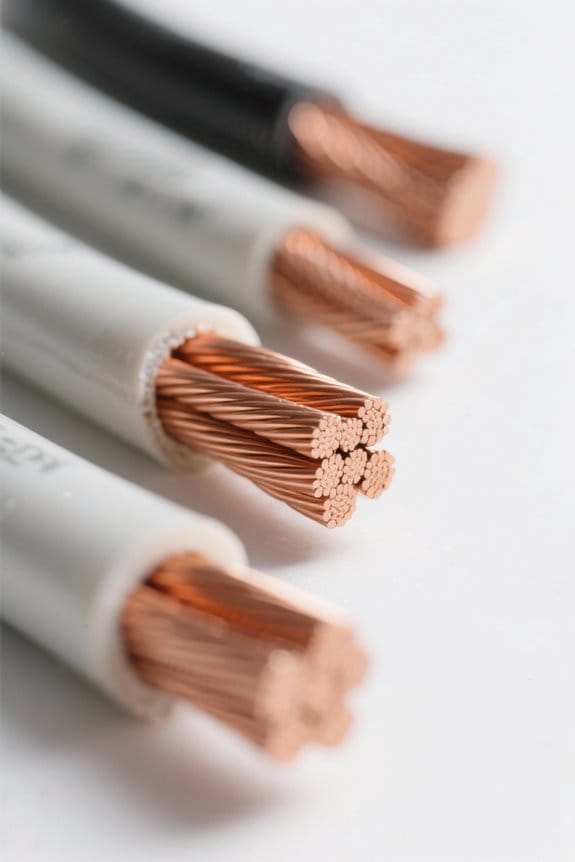
As electrical current flows through a wire, the inherent resistance generates heat, which can significantly affect performance. The resistance of the cable is directly linked to heat generation; thinner wires, or higher AWG, create more resistance than thicker, lower AWG wires. For instance, an AWG 28 wire produces approximately 0.5 ohms of resistance at 2 meters, leading to significant heat build-up. This heat translates to power loss, reducing charging speed and efficiency due to diminished current capacity. To optimize charging performance, using cables with lower AWG, like AWG 24, can minimize resistance and consequently heat generation. Effective heat management is essential, especially during fast charging, to guarantee devices receive adequate power without overheating. Additionally, selecting cables that support fast charging capabilities can further enhance the efficiency of power delivery during use.
Impact of Cable Length on Charging Speed

While some may overlook the significance of cable length, it plays a critical role in determining charging speed and efficiency. Longer cable lengths increase overall resistance, which can impede charging performance. For instance, a 2-meter cable may lead to a voltage drop that markedly reduces the power reaching the device, especially during high-power charging. Consequently, charging speed can decrease by up to 20% when compared with a 1-meter cable. For best results and fast charging capabilities, it is advisable to use shorter cables around 1 meter. This length minimizes losses and guarantees efficient current flow, facilitating better charging speed and performance without any detrimental voltage drop. Regarding cable gauge, thicker wires can help but length should still be considered. Additionally, selecting cables that support fast charging technologies ensures optimal performance during use.
Voltage Drop Explained

Voltage drop is a critical factor affecting the performance of electrical cables, typically stemming from the resistance present in the wire. As the length of the cable increases, so does the voltage drop, particularly in thinner wires like AWG 28, which can experience a voltage drop of about 0.5 Ω over just 2 meters. This significant reduction impacts charging efficiency, particularly for lithium-ion batteries, where a voltage drop of even 0.7 volts can noticeably slow charging speed. To guarantee ideal power delivery, thicker wires, such as AWG 10 or AWG 6, are recommended for longer cable runs exceeding 50 feet. Using adequate cable gauge minimizes voltage drop and helps maintain faster charging times, especially for devices like UPS systems and electric vehicles. Heavy-duty cords enhance safety and longevity, making them a preferable choice for high-powered applications.
Fast Charging vs. Normal Charging Cables
What distinguishes fast charging cables from normal charging cables primarily lies in their construction and capabilities. Fast charging cables typically utilize thicker wires, ranging from 24 to 26 AWG, while normal charging cables often use thinner wires of 28 to 30 AWG. This difference in wire gauge allows fast charging cables to support higher current flow, facilitating faster charging speeds, often exceeding 20W. In contrast, normal charging cables generally limit power to 10-15W, resulting in slower charging. Additionally, the thicker wires in fast charging cables better manage heat generation, enhancing safety and efficiency. Meanwhile, subpar materials in normal charging cables can lead to increased wear, heat buildup, and reduced charging efficiency, compromising both cable longevity and device health. Fast charging cables are often paired with high-power USB C car chargers, ensuring optimal performance and rapid device charging.
Recommended Products

Short and Portable : 0.5ft /15cm/6inch length for charging your phone with a power bank or portable charger; tangle resistant and handy to carry in your bag or pocket. !!! NOTE: For Android Auto use, please make sure that 1, your phone has downloaded relative APP. 2, Your car supports Android Auto function.

The information below is per-pack only

Tether and sync your Digital and Mirrorless Camera to your laptop or desktop other USB-C devices to your desktop for fast and easy file, photo and video transfers.
The Role of E-Marker Chips in Cable Performance
E-Marker chips serve an essential role in enhancing the performance of USB-C cables, particularly when it comes to power delivery and data transfer efficiency. These chips enable higher power delivery capabilities, allowing compatible systems to negotiate voltage and current levels up to 100W, maximizing charging speed. When integrated into high-quality cables, E-Marker chips guarantee that both fast charging and data transfer demands are met without overheating. In contrast, cables lacking E-Marker technology typically limit power delivery to a mere 15W, reducing the overall charging efficiency for devices requiring higher power. Additionally, E-Marker chips protect devices by signaling when the cable approaches its power limits, preventing potential damage from excessive heat or current flow. This intelligence is vital in today’s fast-paced technology environment. Cables like INIU offer 240W fast charging capabilities, showcasing the importance of selecting cables with advanced technology.
Recommended Products

【3-in-1 Transmitter&Receiver&Monitor】Accsoon CineView M7H Pro hdmi camera filed monitor integrates a monitor, transmitter, and receiver into one compact unit. suiting every shooting scenario. Monitor Mode: Connect via HDMI/3G-SDI for a pro 7-inch wired monitor (clear, stable monitoring). RX Mode: Built-in 2.4GHz+5GHz dual-band, pair with CineView Master 4K/4K Lite/SE 4K/HE/SE/2 SDI/QUAD transmitters for 1200FT/350m range, 60ms latency. TX Mode: Works with CineView Master 4K/4K Lite/SE 4K receivers, M7 Pro/M7H Pro RX mode and smart And-roid & iOS devices, total up to 4 devices for real-time monitoring

HIGH-SPEED DATA TRANSFER: USB4 certified cable supports 40Gbps data transfer speeds with backward compatibility for 20Gbps, 10Gbps, 5Gbps, 480Mbps, 12Mbps, and 1.5Mbps for seamless connectivity across all USB versions from 1.0 to 4.0.

Up to 240W PD3.1 Fast Charging: Utilizing the advanced USB PD 3.1 fast charging protocol, our extension cable & short cables support high-speed charging up to 240W (48V 5A) output when used with a compatible charger, compatible with virtually any USB-C device from phones and tablets to laptops
Material Quality and Its Effect on Durability
The quality of materials used in charging cables directly affects their durability and overall performance. Cables constructed with high-quality copper wires demonstrate better conductivity and lower resistance, enhancing their lifespan. In contrast, cables using thinner wires, often associated with lower gauge numbers, may fail sooner due to increased wear and stress. The gauge, measured in AWG, plays an essential role; lower AWG numbers indicate thicker wires that can withstand more physical challenges. Additionally, cables with braided jackets provide superior durability compared to those with PVC sheaths, as they resist fraying. Quality connectors, particularly those with gold plating, help prevent corrosion and guarantee a secure fit, further boosting the overall durability of the cable for effective charging. Moreover, surge protection ratings can enhance safety during charging by preventing damage from electrical spikes.
Heat Dissipation Strategies in Charging Cables
Although charging cables serve a fundamental role in powering devices, their heat dissipation strategies greatly impact performance and safety. Cables with lower AWG ratings, like 24 or 26, generate less heat due to reduced electrical resistance, facilitating better heat dissipation. Many quality charging cables utilize heat-resistant materials in their jackets, thereby preventing overheating during extended use. Moreover, modern USB-C cables often include E-Marker chips that manage power delivery, ensuring ideal temperatures during fast charging. Additionally, braided cable jackets enhance flexibility and airflow, resulting in improved cooling properties. Efficient cable design that emphasizes heat management can greatly extend the lifespan of the cable while safeguarding connected devices from potential thermal damage during high-current charging sessions. Furthermore, safety features such as surge protection in power strips can further enhance the overall safety during charging by preventing electrical overloads.
Recommended Products

High-Power 12V Heating: This men’s heated quilted vest features a 12V high-power system with a 30% larger heated pad, providing a comfortable and intense heating experience up to 144°F, perfect for harsh cold weather. The battery has dual DC output for all Venustas 12V/7.4V heated apparel.
![ORORO [Upgraded Battery] Men's Heated Jacket with Heated Collar, Up to 13.5 Hours, Heated Coat with Removable Hood (Black/Blue,L)](https://m.media-amazon.com/images/I/41yPApJ7+7L._SL500_.jpg)
Upgraded Battery Performance: 7000mAh capacity for up to 13.5 hours of heat. PD fast charging (30W output / 24W input) cuts downtime with a 3-hour full recharge and a built-in USB-C cable for device charging on the go (charger not included).

LONGER-LASTING DAILY WARMTH: Enjoy up to 13.5 hours of steady warmth on low setting, helping you stay comfortable through commuting, dog walks, school runs, errands, countryside walks, and long winter days without interruption.
Choosing the Right Cable Gauge for Speed
Selecting the appropriate cable gauge is essential for achieving ideal charging speeds and performance. Lower AWG numbers indicate thicker wires, which greatly reduce resistance. For instance, fast charger cables utilizing AWG 24 can handle higher current loads effectively compared to thinner AWG 28 cables. By increasing wire gauge from 28 to 24, resistance can decrease by about 40%, allowing the charging current to rise from 500mA to approximately 2A. Thicker cables not only facilitate higher power transfer but also dissipate heat more effectively, promoting safety during fast charging. As a result, when choosing cables, it is advisable to opt for those made with lower AWG to minimize resistance and enhance overall charging efficiency, ensuring devices can charge quickly and safely. Additionally, using cables that support fast charging can significantly improve charging times for high-end devices.
Future Trends in Charging Cable Technology
As technology advances, future trends in charging cable design are expected to focus on enhancing performance through innovative materials and smarter functionality. The integration of advanced materials like graphene may greatly improve conductivity while reducing heat generation. Additionally, the upcoming USB 4.0 standard is anticipated to offer power delivery capabilities of up to 40 Gbps, enabling faster charging speeds across devices. Innovations will likely include smart charging cables with sensors that monitor power delivery, cable health, and temperature for improved safety. Designers are also focusing on higher AWG cables to balance flexibility with lower resistance, enhancing heat dissipation. The expansion of Power Delivery protocols will further facilitate rapid charging across various electronics, ensuring efficiency for users.
Frequently Asked Questions
Do Thicker Cables Charge Faster?
Thicker cables indeed charge faster. Their increased cable thickness improves charging efficiency, enhances current capacity, and reduces voltage drop, while also aiding in heat dissipation. Material quality and insulation types further optimize the overall performance.
Can Cable Affect Charging Speed?
Cables greatly affect charging speed; their conductivity and resistance impact determine heat generation and voltage drop. Higher quality materials and proper amperage ratings guarantee charger compatibility, optimizing efficiency and enhancing overall device charging performance.
Why Is My EV Charger Not Charging at Full Speed?
The EV charger struggled, akin to a dimly lit bulb flickering in darkness. Charging issues stemmed from voltage drop, cable length, incompatible connectors, and inadequate outlet compatibility, hindering the power supply and adherence to charging standards.
Can a Bad Cable Cause Slow Charging?
A bad cable can considerably impede charging efficiency due to poor cable quality, resulting in increased resistance factors, voltage drop, compromised material conductivity, heat generation, and diminished connector integrity, ultimately leading to slower charging speeds.


