As an Amazon Associate, we earn from qualifying purchases. Some links on this site are affiliate links at no extra cost to you. Our recommendations are based on thorough research and editorial judgment.


Battery Chemistries in UPS Systems: SLA Vs Lithium Considerations

When choosing a battery for uninterruptible power supply (UPS) systems, sealed lead acid (SLA) and lithium-ion (Li-ion) batteries present distinct advantages. SLA batteries typically last 3-5 years and require more maintenance, while Li-ion batteries offer an extended lifespan of 8-10 years with minimal upkeep. Li-ion batteries charge faster, operate efficiently in cold conditions, and take up less space. These features often make Li-ion the preferred choice for critical applications, and further details will clarify this decision-making process.
Key Takeaways
- Lithium-ion batteries have a longer lifespan (8-10 years) compared to lead-acid (3-5 years), offering better longevity for UPS systems.
- With faster charging times (1-2 hours), lithium batteries enhance operational efficiency and reduce downtime compared to SLA batteries (8-16 hours).
- Lithium-ion batteries require less maintenance, leading to lower total cost of ownership (TCO) when factoring in lifespan and replacement costs.
- High energy density in lithium batteries allows for deeper discharges (80-90%) and occupies significantly less space than lead-acid options.
- Safety features like integrated Battery Management Systems in lithium batteries enhance reliability over lead-acid batteries, which lack such technology.
Overview of UPS Battery Types
You may be interested


Uninterruptible Power Supply (UPS) systems are critical for maintaining power during outages, and the battery type chosen can greatly impact performance. The two primary options for UPS applications are Sealed Lead Acid (SLA) batteries and Lithium-ion batteries. SLA batteries are favored for their reliability and lower initial costs, typically lasting 3-5 years. In contrast, Lithium-ion batteries are becoming increasingly popular due to their extended lifespan of 8-10 years and higher energy density. Additionally, lithium-ion batteries charge faster, often completing a full charge in 1-2 hours compared to the 8-16 hours needed for SLA batteries. When selecting a battery type, factors such as application requirements, budget constraints, and maintenance needs play a significant role in determining the best choice for users. Furthermore, the high-quality materials used in lithium-ion batteries contribute to their overall durability and performance.
Benefits of Lead-acid Batteries

Lead-acid batteries present a compelling option for users seeking reliable power solutions within UPS systems. Known for their lower upfront cost, these batteries appeal to budget-conscious consumers. With a proven reliability track record, lead-acid batteries have been utilized in various applications for decades, particularly in UPS systems. They excel in delivering high currents for short durations, making them ideal for spiky load demands, such as powering servers and networking equipment. Additionally, lead-acid batteries demonstrate greater resistance to physical damage compared to lithium alternatives, enhancing their durability in challenging environments. Importantly, they can charge in cold weather without facing the same challenges that lithium batteries encounter, providing a practical advantage in specific applications. Furthermore, these batteries are often paired with surge protectors rated for 1000 joules, ensuring the safety and longevity of connected devices in UPS systems.
Advantages of Lithium Batteries

While many users prioritize cost in their selection of batteries for UPS systems, lithium batteries offer numerous advantages that enhance their overall value. With a lifespan of 8-10 years, lithium batteries considerably outlast the typical 3-5 years of lead-acid batteries, reducing replacement frequency and maintenance costs. Additionally, they feature a cycle life that can last up to 25 times longer than their lead-acid counterparts, easily enduring thousands of cycles. These batteries also charge four times faster than lead-acid options, minimizing downtime in critical applications. Furthermore, lithium batteries maintain a consistent power output throughout their discharge cycle, preventing the performance dips often seen in lead-acid batteries. Weighing up to 55% less, they facilitate easier management in mobile and remote installations. Moreover, the safety features of lithium batteries, such as built-in protections against overheating, contribute to their reliability in UPS systems.
Recommended Products

【32153Wh LiFePO4 Battery】 Dawnice’s newest line of batteries –2 sets 51.2V 314Ah LiFePO4 battery provides 6000+ cycles & a 10 years lifetime with built-in 100A Battery Management System (BMS) protects it from overcharge, deep discharge, overloading, overheating and short circuit, and excessive low self-discharge rate. Support in parallel up to 16 sets, can be expanded in the future.

【10 Years of Peace of Mind】Trusted by 6M+ users worldwide, our leading PV inverter brand provides a 10-year product quality assurance and local support, ensuring fast, reliable service and assistance whenever you need it, right in your area.

【24 hours Customer Service】Cloudenergy provides technical support and online customer service with fast feedback within 24 hours. If you have any product-related issues or questions, please get in touch with us directly, Cloudenergy support team is always here for you.
Performance Characteristics of Lithium Batteries

Lithium batteries excel in delivering consistent and reliable performance characteristics that set them apart from traditional battery options. Their voltage remains steady throughout the discharge cycle, ensuring reliable power delivery, unlike lead acid batteries. Charging is notably faster, with lithium-ion batteries charging up to four times quicker, enhancing operational efficiency. These batteries offer a remarkable battery life, achieving 8-10 years compared to 3-5 years for lead acid. They maintain about 70% capacity at 0°F, outperforming lead acid batteries that drop to 45% under similar conditions. The high energy density of lithium batteries allows for depths of discharge between 80-90%, supported by an effective Battery Management System (BMS) to optimize performance. These factors make lithium batteries a superior choice for UPS systems. Additionally, lithium batteries typically provide over 5000 charge cycles, significantly enhancing their longevity and cost-effectiveness.
Maintenance Requirements and Total Cost of Ownership (TCO)
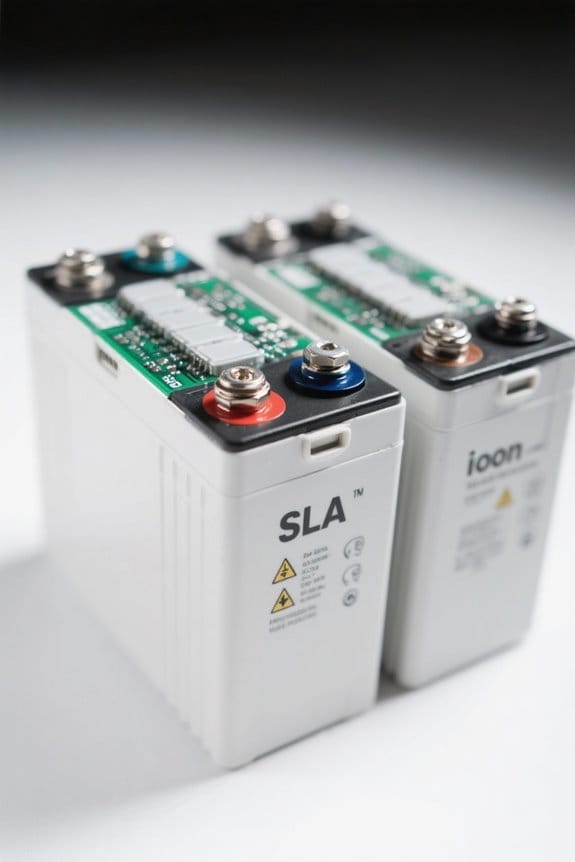
The maintenance requirements and total cost of ownership (TCO) are critical factors when evaluating battery options for uninterruptible power supply (UPS) systems. Lithium batteries generally demand less maintenance compared to traditional lead-acid batteries, which require biannual inspections and upkeep. Consequently, lithium batteries can lower the overall TCO through reduced operational expenses. Their impressive longevity spans 8-20 years, enduring up to 25 times more charge cycles than lead-acid options, which typically last only 3-5 years. Although the initial purchase price of lithium batteries may be higher, the diminished need for replacements ultimately leads to cost savings. As a result, investing in lithium batteries often proves to be more economically favorable over time, making them a worthwhile consideration for UPS systems. Moreover, many users find that lithium batteries offer higher capacity options, further enhancing their appeal for reliable power solutions.
Recommended Products

Self-Heating Function: Automatically activates when charging at -20C to 5C (-4F to 41F). Choose between Regular and Energy-efficient heating modes via the LiTime APP for optimal cold-weather performance

High Capacity & Energy: 230Ah capacity and 5888Wh energy provide extended power for Home Power, RVs, boats, and off-grid use. Enjoy longer runtime and reliable energy in a compact design.

【800W Solar Panel Kit】The 800W off grid solar system complete kit is equipped with 25.2% High-Efficiency Solar Cell 200W bifacial solar panels and 12V 3000W inverter charger for the first time. It not only has higher power generation efficiency, more beautiful all-black appearance, and easier installation, but also uses the UPS power function to provide you with extremely fast conversion power supply of two energy sources. It can not only generate electricity with solar energy, but also charge with mains electricity, allowing you to enjoy your RV trip without worries
Comparison of Lifespan Between SLA and Lithium Batteries
Battery lifespan is a crucial aspect when evaluating different options for energy storage in uninterruptible power supply (UPS) systems. Lithium batteries generally offer a lifespan of 8-10 years, greatly outlasting sealed lead acid (SLA) batteries, which typically last 3-5 years. Regarding cycle life, lithium deployments can endure 3,000-5,000 cycles, while lead acid batteries usually manage only 200-300 cycles before capacity starts to decline. Additionally, lithium batteries maintain up to 80-90% of usage capacity, whereas SLA batteries are limited to about 50%. This capacity degradation is particularly pronounced at higher discharge rates. The extended lifespan and efficiency of lithium batteries contribute to a lower total cost of ownership compared to lead acid batteries, making them a more practical choice for long-term energy storage. Furthermore, the surge protection ratings of lithium batteries also play a significant role in their reliability during power fluctuations.
Recommended Products

[All-Scenario Power] - Apex 300 (2764.8Wh, 3840W) keeps homes lit, RVs rolling & off-grid sites running. Parallel 2-3 units (5.5-8.3kWh), expand to 58kWh with B300K. Never powerless.

【Long Lifespan & Cost Efficiency】With 6,000 deep cycles at 80% depth of discharge—equivalent to 10+ years of reliable service, this 12v 640Ah 4 PACK lifepo4 battery far outperforms lead-acid alternatives while significantly reducing long-term costs. Its massive 640Ah capacity delivers 8,192Wh of energy storage with over twice the energy density of comparable lead-acid batteries, all backed by a 5-year warranty and 24/7 customer support.

[Energy Independence] - Apex 300 power station, B300K expansion battery (5.5kWh, 3840W, 7680W surge) delivers off-grid power for essentials, lights, and devices. Ideal for cabins, camping, and backup.
Weight and Space Considerations
Weight and space considerations play a significant role in the selection of battery technology for UPS systems. Lithium batteries are generally 55% lighter than lead-acid ones, which is advantageous for mobile and remote applications where weight is a critical factor. Additionally, lithium batteries occupy up to 60% less space compared to their lead-acid counterparts, allowing for more efficient storage solutions. This compact size means that installation in space-constrained environments, like server rooms, becomes more feasible. Moreover, lithium batteries can be installed in any position without risking leaks, unlike lead-acid batteries that need proper venting. By reducing both weight and space requirements, lithium batteries enhance system portability, making them ideal for marine environments and off-grid systems. This advantage mirrors the benefits of using compact power banks for efficient on-the-go charging.
Safety Aspects of Lithium-ion vs. Lead-acid Batteries
When evaluating safety aspects of lithium-ion and lead-acid batteries, one must consider several key factors that differentiate their performance and risk profiles. Lithium-ion batteries come equipped with an integrated Battery Management System (BMS) which actively regulates charge rates, voltage, and temperature. This considerably enhances safety and minimizes risks, including the dangerous phenomenon of thermal runaway. In contrast, lead-acid batteries do not possess an integrated BMS, making them less adept at managing specific battery characteristics and safety risks. While both battery types face potential safety issues, such as combustion, lithium-ion batteries necessitate stricter monitoring and handling procedures due to their propensity for overheating. Additionally, proper recycling and disposal of lithium-ion batteries are critical to mitigating environmental and health risks. Furthermore, safety certifications for lithium-ion batteries can provide assurance of their reliability and performance in various applications.
Recommendations for Battery Selection and Application
In selecting an appropriate battery for uninterruptible power supply (UPS) systems, several factors must be evaluated to guarantee peak performance and efficiency. Lithium batteries are often preferred for mission-critical operations due to their lifespan of 8-10 years, considerably outlasting lead-acid batteries, which last only 3-5 years. They are also more efficient, charging four times faster and occupying up to 60% less space, making them suitable for tight environments. When considering Total Cost of Ownership (TCO), lithium batteries present long-term savings through reduced maintenance and fewer replacements, despite higher initial costs. For home offices or back offices with moderate power demands, either battery type can suffice, but lithium batteries enhance performance and energy efficiency, especially in applications with varying workloads. Additionally, high power capacity UPS units are essential for supporting multiple devices during outages, which can further influence battery selection.
Recommended Products

Seamless for Victron Integration: Seamless compatible with Victron Cerbo GX via CAN. Supports DVCC(Distributed Voltage and Current Control) for optimized charging and VRM for remote monitoring, enhancing efficiency and lifespan.

[Get Up to a 30% Tax Credit] You may be eligible for the Residential Clean Energy Credit on qualified solar electric property costs. Check with your utility provider to confirm your eligibility and understand the requirements for the program.

This Package contains 4 Packs of Redodo 25.6V 100Ah LiFePO4 Lithium Battery.
Frequently Asked Questions
What Is the Best Battery Chemistry for UPS?
The best battery chemistry for UPS systems is lithium due to its superior energy density, faster charging capabilities, and longevity, despite lead acid advantages such as initial lower costs, which may appeal to budget-conscious users.
Are SLA Batteries Lithium?
SLA batteries and lithium batteries are distinct entities, the former offering cost advantages and shorter lifespans. In contrast, lithium excels in longevity, showcasing an enigmatic allure of extended service, enabling users to ponder their investment for the future.
Why Don’t UPS Use Lithium Batteries?
UPS systems often avoid lithium batteries due to cost factors, safety concerns regarding overheating, and the need for system modifications. The longevity comparison favors lithium, but initial expenses and compatibility issues hold back widespread adoption.
What Is the 80 20 Rule for Lithium Batteries?
The 80/20 rule for lithium batteries promotes ideal lifespan and battery efficiency by maintaining charge levels between 20% and 80%. This practice enhances performance, extending charging cycles and reducing capacity degradation considerably over time.


